top of page


2020
Thesis research, individual
Politecnico di Milano
User Experience, Research
Thesis advisor → Matteo Ciastellardi
Read the full project on PoliTesi
How much is our attention worth?
Ethical design for user's digital wellbeing
The UX research focuses on attention, analyzing user’s issues related with digital products and services. Neuroscience and psychology demonstrate that attention is a limited resource and that the user has changed his habits to be able to be always-on, often developing psychological and cognitive problems such as distraction, tecnostress and nomophobia.
In this scenario is developing a desire to design according to a new ethics which aims to the user’s digital well-being. A technology that respects human vulnerabilities, without distracting our minds, but helping us to achieve personal goals.
PROBLEM
• Attention economy produces value increasing time spent online
• Continuous stimuli constantly catch our attention, creating interruptions that distract us from daily life
RESEARCH GOALS
• Analyze how attention is structured and what brings distraction
• Explore persuasive design methods related to attention economy
• Hypothesize guidelines for an ethical design approach, that respects user’s vulnerabilities and attention
CASE STUDY ANALYSIS
• Identification of Target audience
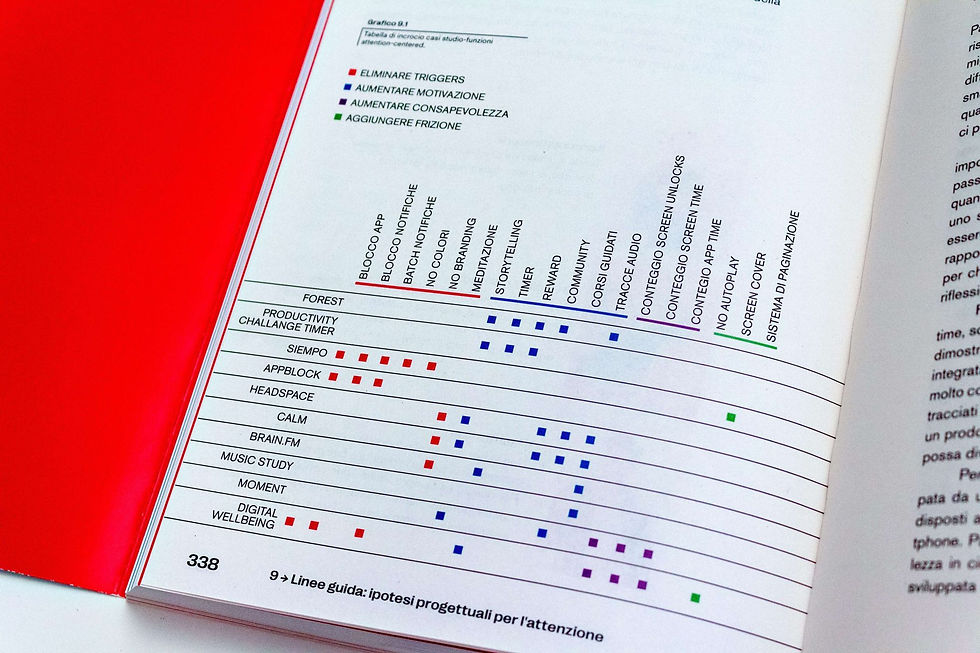
• Selection of 10 app case studies (Forest, Productivity Challenge Timer, Siempo, Appblock, Headspace, Calm, Brain.fm, Music Study, Moment, Digital Wellbeing)
• Identification of the comparing analysis criteria
• Analysis of the user journey
HOW TO DESIGN FOR THE ATTENTION
The research goal is to identify useful guidelines for a technoetic design that considers a set of psychological, scientific and environmental factors, to improve productivity and attentive skills of the user.
REMOVE INTERNAL TRIGGERS
Isolate yourself and carve out moments of disconnection. Daily meditation exercises can prepare for periods of concentration.
ADD FRICTION
Against mechanisms of frictionless experience, introduce functions that add friction to usability, decreasing automation and increasing intentionality and awareness
INCREASE AWARENESS
Observation of user’s digital habits, through screen time and screen unlocks monitoring
INCREASE MOTIVATION
Use the Pomodoro Technique, a productivity strategy to fight procrastination and complete tasks without being distracted.
REMOVE EXTERNAL TRIGGERS
Eliminate habits by acting on what triggers them, such as notifications and sounds. Functional music to isolate from the surrounding environment.


Say Hello! ↘
Giulia Benigni © 2021 → Website designed and built through Wix Playground Academy, late nights, chocolate and fun :)
Say Hello! ↘
2020
Thesis research, individual
Politecnico di Milano
User Experience, Research
Thesis advisor → Matteo Ciastellardi
Read the full project on PoliTesi
The UX research focuses on attention, analyzing user’s issues related with digital products and services. Neuroscience and psychology demonstrate that attention is a limited resource and that the user has changed his habits to be able to be always-on, often developing psychological and cognitive problems such as distraction, tecnostress and nomophobia.
In this scenario is developing a desire to design according to a new ethics which aims to the user’s digital well-being. A technology that respects human vulnerabilities, without distracting our minds, but helping us to achieve personal goals.
How much is our attention worth?

The Gradient, Walker’s new Design Quarterly is the redesign of the authentic Design Quarterly magazine, edited by the Walker Art Center museum of Minneapolis from 1954 to 1996.
The concept is based on the museum’s omonimous online publication, which is linked to the idea of the gradient itself. This idea is represented as the connection between design and other topics that change in every issue. In this first volume the topic "How do we translate sound?" represents the relationship between music and design.
The gradient appears as a graphic index that drives you through the magazine sections:
Inside Walker is the physical counterpart of the online blog;
Outside Walker is a collection of works to discover emerging contributors from all over the world.
Giulia Benigni © 2022 → Website designed and built through Wix Playground Academy, late nights, chocolate and fun :)
Say Hello! ↘
Say Hello! ↘

PROBLEM
• Attention economy produces value increasing time spent online
• Continuous stimuli constantly catch our attention, creating interruptions that distract us from daily life

RESEARCH GOALS
• Analyze how attention is structured and what brings distraction
• Explore persuasive design methods related to the attention economy
• Hypothesize guidelines for an ethical design approach, that respects user’s vulnerabilities and attention


CASE STUDY ANALYSIS
• Identification of Target audience
• Selection of 10 app case studies
• Identification of the comparing analysis criteria
• Analysis of the user journey


How to design for the attention
The research goal is to identify useful guidelines for a technoetic design that considers a set of psychological, scientific and environmental factors, to improve productivity and attentive skills of the user.
1. REMOVE INTERNAL TRIGGERS
Isolate yourself and carve out moments of disconnection. Daily meditation exercises can prepare for periods of concentration.
2. INCREASE MOTIVATION
Use the Pomodoro Technique, a productivity strategy to fight procrastination and complete tasks without being distracted.
3. ADD FRICTION
Against mechanisms of frictionless experience, introduce functions that add friction to usability, decreasing automation and increasing intentionality and awareness
4. REMOVE EXTERNAL TRIGGERS
Eliminate habits by acting on what triggers them, such as notifications and sounds. Functional music to isolate from the surrounding environment.
5. INCREASE AWARENESS
Observation of user’s digital habits, through screen time and screen unlocks monitoring


2018
Group project
Politecnico di Milano
Content research, Editorial design
Lab Artefatti e sistemi complessi
Prof → Elena Caratti, Massimo Pitis
Team → Benedetta Belpasso, Filippo Ferrari, Alice Maturo, Enrico Novello
Read the full project on Issuu
The
Gradient


The Gradient, Walker’s new Design Quarterly is the redesign of the authentic Design Quarterly magazine, edited by the Walker Art Center museum of Minneapolis from 1954 to 1996.
The concept is based on the museum’s omonimous online publication, which is linked to the idea of the gradient itself. This idea is represented as the connection between design and other topics that change in every issue. In this first volume the topic "How do we translate sound?" represents the relationship between music and design.
The gradient appears as a graphic index that drives you through the magazine sections:
Inside Walker is the physical counterpart of the online blog;
Outside Walker is a collection of works to discover emerging contributors from all over the world.
Giulia Benigni © 2021 → Website designed and built through Wix Playground Academy, late nights, chocolate and fun :)
Say Hello! ↘
Say Hello! ↘


The Gradient, Walker’s new Design Quarterly is the redesign of the authentic Design Quarterly magazine, edited by the Walker Art Center museum of Minneapolis from 1954 to 1996.
The concept is based on the museum’s omonimous online publication, which is linked to the idea of the gradient itself. This idea is represented as the connection between design and other topics that change in every issue. In this first volume the topic "How do we translate sound?" represents the relationship between music and design.
The gradient appears as a graphic index that drives you through the magazine sections:
Inside Walker is the physical counterpart of the online blog;
Outside Walker is a collection of works to discover emerging contributors from all over the world.
bottom of page